Multics (Multiplexed Information and Computing Service)
Massachusetts Institute of Technology, Bell Labs, and General Electric were jointly developing an experimental time-sharing operating system called Multics for the GE-645 mainframe. Multics introduced many innovations, but also had many problems. Bell Labs, frustrated by the size and complexity of Multics but not its aims, slowly pulled out of the project.
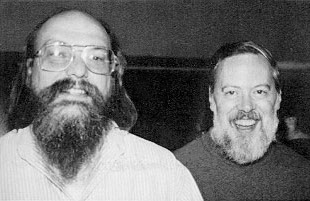
Ken Thompson (left) and Dennis Ritchie (right)
Unix
After that, the two Bell Labs researchers, Ken Thompson and later Dennis Ritchie, started a simpler system on a DEC PDP-7 computer. That system became Unix.
Unix splits into major branches. Two main lineages emerged:
AT&T System V
Official commercial Unix line from AT&T.
BSD (Berkeley Software Distribution)
From University of California, Berkeley
GNU Project
GNU stands for: GNU’s Not Unix
That name is intentional. It means the project wanted to build a Unix-like operating system, but not actually use Unix code.
The GNU Project was started in 1983 by Richard Stallman. The goal was to create a completely free software operating system.

GNU had most of a working operating system, but it was missing one critical piece: a stable kernel.
Linux
Linux is the kernel, not the whole operating system by itself.
It was created in 1991 by Linus Torvalds as a hobby project while he was a student in Finland. He wanted a Unix-like kernel for his PC.

By itself, Linux is not a full user-facing OS. That is why people often say GNU/Linux: the system is usually the Linux kernel plus GNU tools and many other components.
Distributions
There is essentially one Linux kernel project, with one main upstream line maintained by Linus Torvalds and kernel developers.
A Linux distribution (often called a distro) is a complete operating system built around the Linux kernel.
All Linux distros share the same kernel, but differ in:
- Package management system
- System philosophy
- Default software
- Release model
Here’s the common Linux distribution families:
Debian family

Most common distros:
- Debian
- Ubuntu
- Linux Mint
- Kali Linux
- Pop!_OS
Red Hat family

Most common distros:
- Fedora
- Red Hat Enterprise Linux (RHEL)
- CentOS Stream
- Rocky Linux
- AlmaLinux
SUSE family

Most common distros:
- openSUSE Leap
- openSUSE Tumbleweed
- SUSE Linux Enterprise (SLES)
Arch family

Most common distros:
- Arch Linux
- Manjaro
- EndeavourOS
- Garuda Linux
Slackware family

Most common distros:
- Slackware
- Salix OS
- Zenwalk Linux
Gentoo family

Most common distros:
- Gentoo Linux
- Funtoo